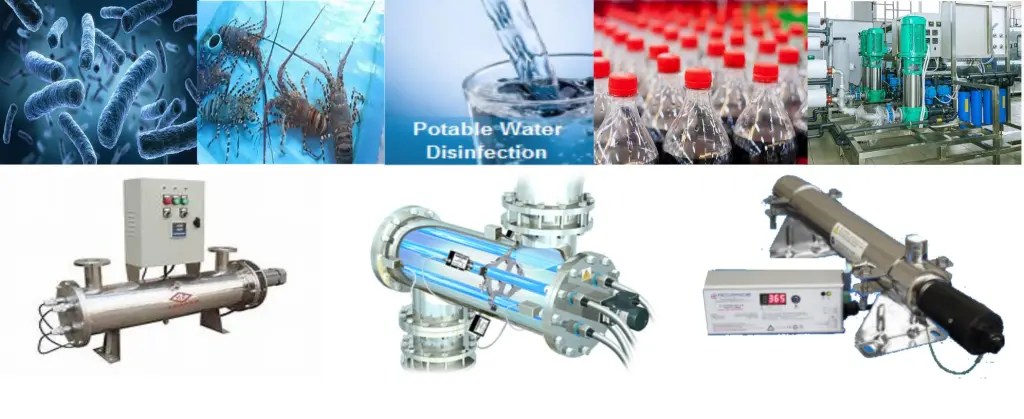
Potable Water Disinfection
As we all know, potable water – i.e. drinking water, comes from natural sources. Most of our drinking water comes from rainwater collected in dams, canals, rivers, lakes, aquifers, or rainwater tanks. Rainwater runoffs from many sources pick up contamination of different types along the way. Waterborne bacteria, viruses, cysts, spores and similar microorganisms are indeed responsible for many contagious diseases. For example, Cryptosporidium outbreaks, Giardia infections, or cases like recent Naegleria fowleri infections can be traced back to microorganisms in water.
As a result, we must adequately treat water to make it safe to drink. Potable water treatment includes multiple steps to remove impurities.
Disinfection is a key step to make water safe to drink.
Disinfection is the process of inactivating microorganisms like bacteria, viruses, protozoa, spores, cysts and the like to make water safe for potable uses.
Ultraviolet Disinfection of Drinking Water
Light with wavelength between 200-280nm is called UVC radiation. UV-C radiation damages the DNA of microorganisms like bacteria, viruses, spores, cysts, oocysts, yeasts, fungi, algae, etc.
UV disinfection of potable water is rapidly becoming the preferred disinfection method because of several key advantages.
Advantages of UV disinfection of Potable Water
- Effective against all known microorganisms. When used correctly, sufficient UV dose protects from all known bacteria, viruses, spores, cysts, oocysts, yeasts, fungi, algae, etc.
- No generate disinfection byproducts in most situations
- Non chemical. So, inherently safe
- Easy to monitor and control in real time
- Online disinfection. No need for mixing tanks or holding periods
- Easy to target log reduction in specific microorganisms, because UV Dose – response curves are available for most common pathogens.
- There is no risk of UV overdosing – generally the higher the UV Dose the better
- Very economical
- No corrosion
- UV Disinfection does not depend on water chemistry, water pH, etc.
Limitations of UV disinfection
- UV disinfection depends on “optical clarity” of the water to UVC wavelength, measured by UVT (UV transmittance) at 254nm. The higher the UVT of water, the more effective the UV disinfection
- UV has no residual effect. As a result, in many situations a small Chlorine residual is recommended
UV Disinfection of Potable Water: Process Flow
While there are variations, the most common process for ultraviolet disinfection of potable water is
Micron filtration -> UV disinfection
UV Dose for drinking water disinfection
UV dose delivered is the most important factor affecting efficacy of UV disinfection.
For potable water disinfection, Australian Drinking Water Guidelines, US EPA UVDGM 2006, and most of EU regulators recommend minimum UV Dose>40mJ/cm2 (i.e. 400J/m2) at the end of recommended UV lamp life.
As mentioned in US EPA (UVDGM 2006), some microorganisms (e.g. viruses) require much higher UV dose to achieve 4 log reduction.


 aquapurehitech-australia.com -